
Rush County Deed Types
Every Rush County deed search starts with the instrument type. The Recorder keeps deeds and the related title instruments filed with them. Before deciding what interest moved, read the recorded heading, the parties, the legal description, and the granting language.
| Deed Type | What It Does | Common Use |
|---|---|---|
| Warranty deed | Conveys the stated estate with covenants | Ordinary sale |
| Quitclaim deed | Conveys the grantor's stated interest without warranties | Family or cleanup transfer |
| Administrator or trustee deed | Conveys under stated fiduciary authority | Estate or trust matter |
| Tax deed | Records transfer after a statutory tax sale | Delinquent-tax property |
| Survivorship affidavit | Places death and survivorship facts of record | Death-related update |
A deed conveys an interest outright. A mortgage or a lien only records a claim against the land. A release shows later that the claim was discharged, so read the full sequence rather than treating one row as the whole condition of title.
Rush County Recorder Access
The Rush County Recorder operates from Courthouse Room 208. That room sits at 101 East Second Street in Rushville. The counter is open Monday through Friday, 8:00 a.m. to 4:00 p.m. Call 765-932-2388 or email recorder@rushcounty.in.gov with questions about deed records. The office links to Doxpop for online access. The page does not state an exact online cutoff, field labels, or image price. Ask staff directly for those details.
Phone, email, counter visits, and mail all work as fallback channels. Anyone mailing a request should include a self-addressed, postage-paid envelope. Staff will not run title searches or offer legal advice. Bring your own parcel number and deed records questions in concrete form.
For hours, contacts, and the Doxpop link, check the official Recorder page. That is the place to look.
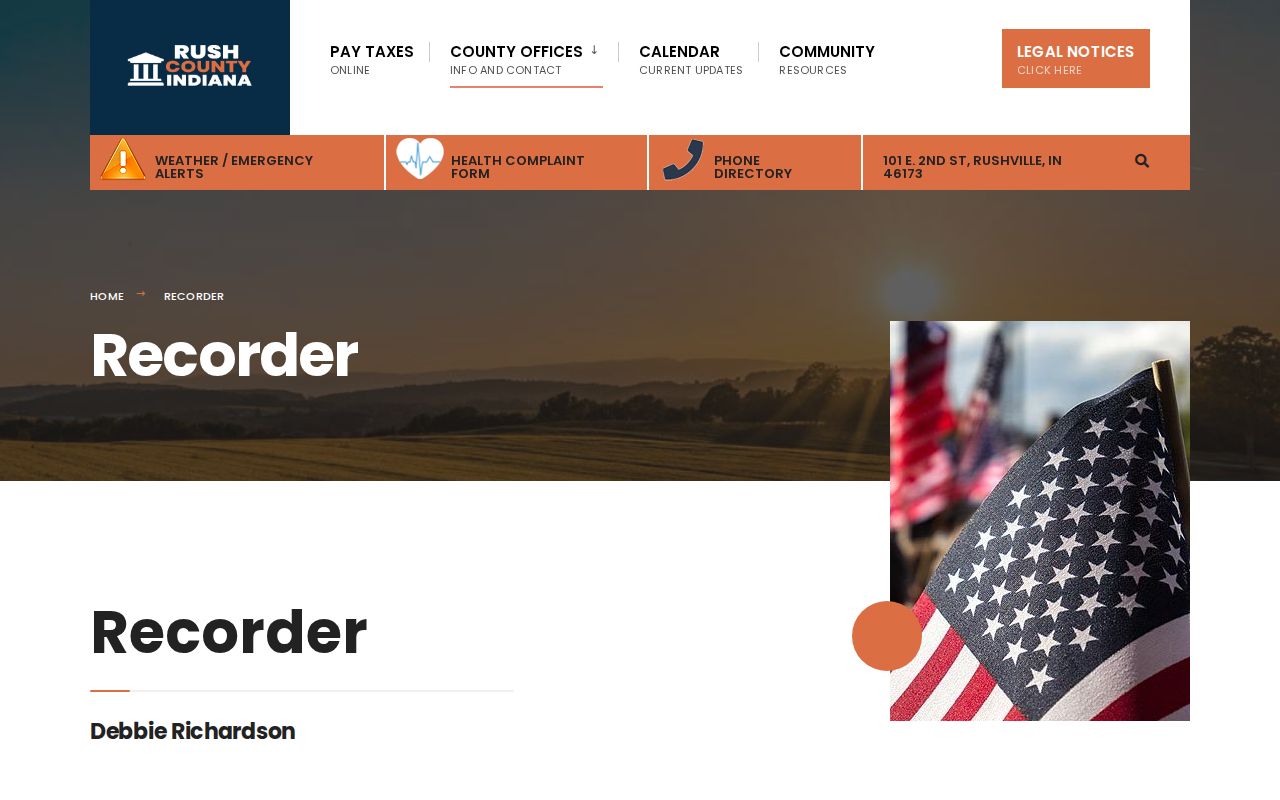
The image confirms the office route and linked services, while the deed image supplies the operative recorded text.
Rush County Recording Rules
Any instrument affecting title needs the County Auditor's transfer signature. The Recorder will not record it without one. The office also publishes mechanic's lien, assumed-business-name, and survivorship forms. A posted form may not fit your transaction. No universal copy price applies, and fees can change. Confirm the current charge and the payment method. Also ask whether your request needs a book-page or instrument reference.
Rush County Grantor-Grantee Trail
A grantor gives up an interest. A grantee receives it. Start from one confirmed modern deed, then move from its grantor to that person's earlier acquiring deed, matching the legal description each time because one name can own several parcels.
- Find the current party's purchase deed with that party as grantee.
- Read the prior owner, recording reference, and full legal description.
- Search that grantor as an earlier grantee and confirm the same land.
- When online coverage stops, move to deed books and State Library microfilm.
- Grantor
- The party conveying the stated interest.
- Grantee
- The party receiving the stated interest.
- Chain of title
- The linked sequence of conveyances for the same land.
- Book and page
- A volume reference used to locate an older instrument.
Rush County Deeds on Microfilm
The Indiana State Library holds grantee deed indexes covering 1822 through 1907. It also holds grantor indexes covering 1827 through 1907. Deed books A through Z run 1820 through 1862. Numbered volumes 1 through 45 continue from 1862 through 1901. Those ranges build a documented early chain for Rush County deed records. They cover whenever online coverage stops.
The State Library map inventory adds 1919 and 1938 owner maps plus later plat books. These orient a search before the matching deed book. The official page lists the full collection.
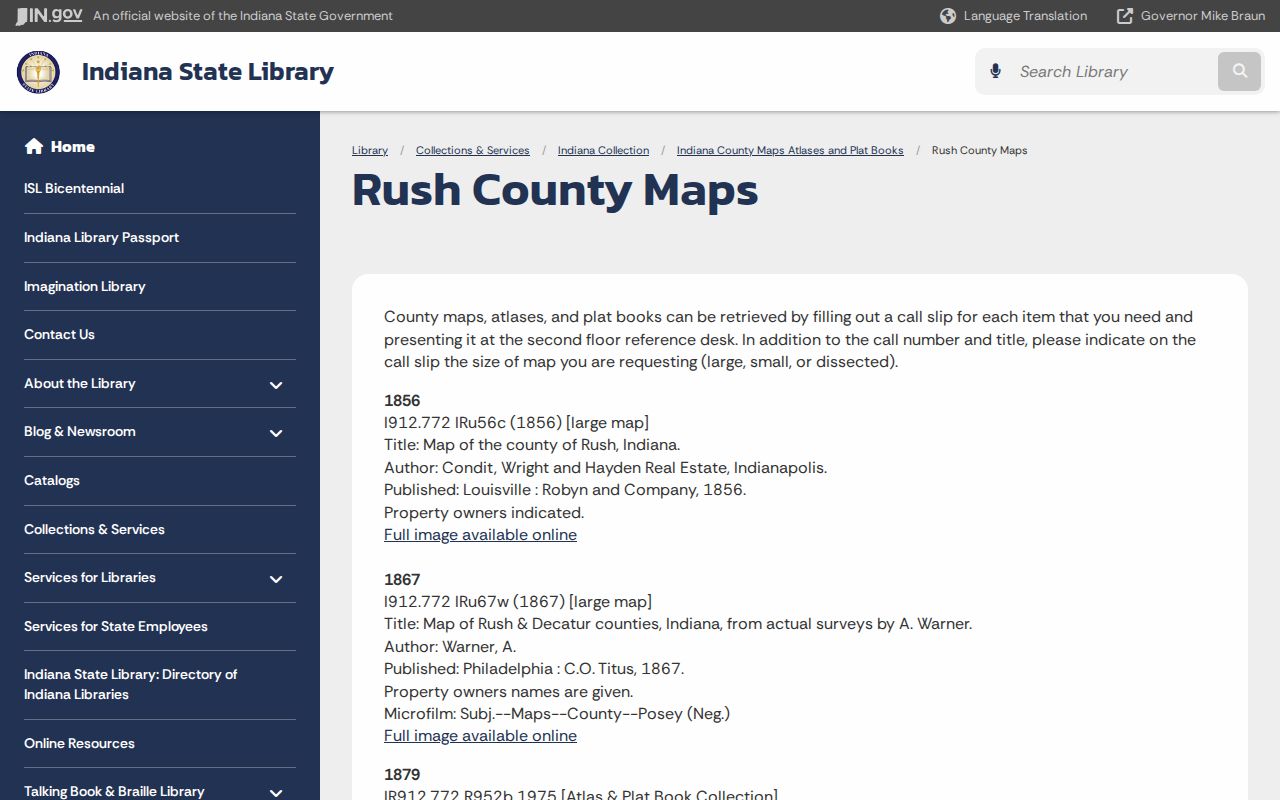
The list names exact map years to request before you return to the matching deed book.
Rush County Plats and Descriptions
Historic plat names hold a chain together when street addresses change. Rushville began as a 151-lot grid. Carthage was first platted in 1834. Exact Rushville strings include P R & A, H G Sexton HRS, Stewart & Pugh, Rushville Villas, and Rush County ECDC Subdivision.
Preserve the punctuation when searching. A parcel may combine several lots or cite a replat. Confirm each relationship in the recorded plat. Confirm it in the deed too, rather than inferring it from a historic map.
Liens Beside Rush County Deeds
Mortgages, assignments, releases, and mechanic's liens run beside deeds as an encumbrance trail. Search both party names and the land description. A proper release points back to the instrument it satisfies. Foreclosure or probate questions may also call for MyCase and a Clerk file check.
State Library microfilm adds probate books from 1822 through 1918. It also holds partition indexes from 1843 through 1919. Administrator real-estate sales run from 1875 through 1886. Those records explain a transfer. They never replace the final recorded deed.
Rush County Property Watch Link
The Recorder links Property Watch for deed monitoring. That JavaScript-only page publishes no field list, fee schedule, or alert rules, so read the current terms yourself. Confirm any notice against the recorded instrument before acting on it.
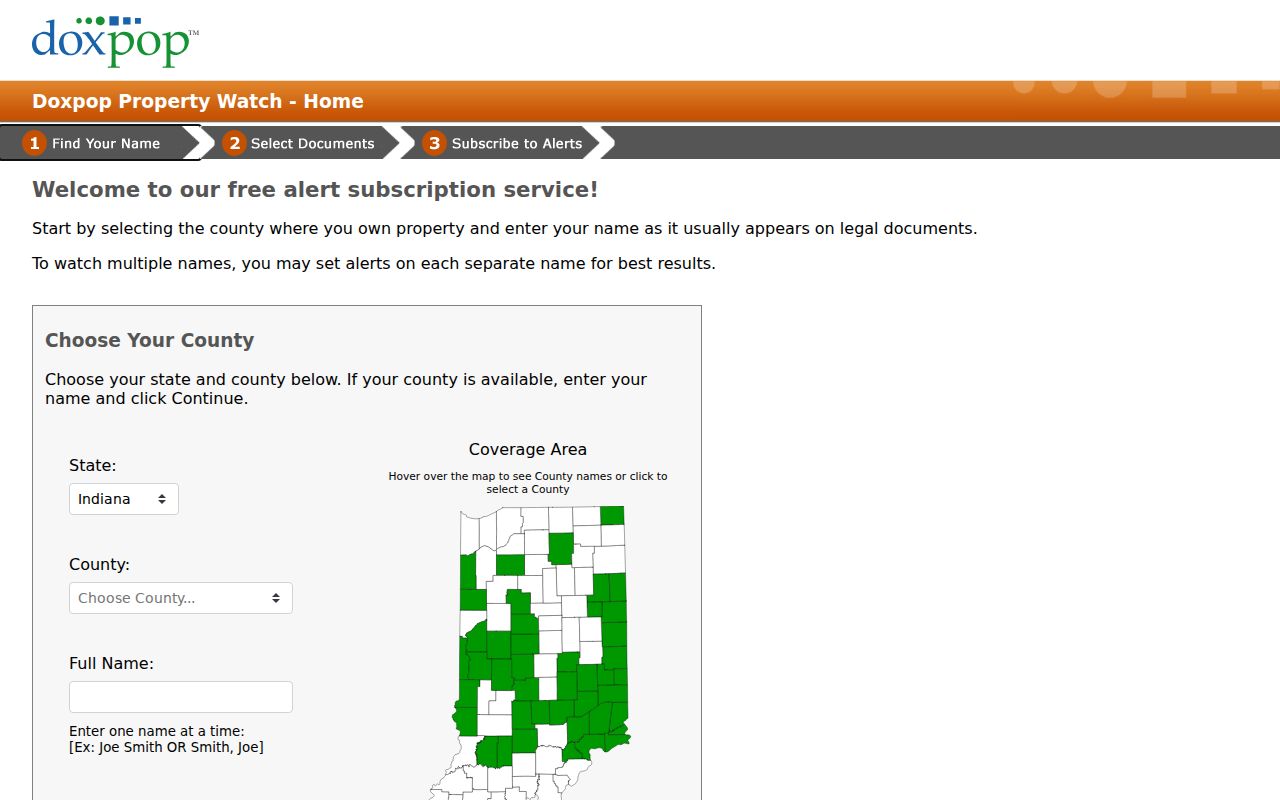
The image confirms the route, not that every deed type or name variant gets monitored.
Rush County Estate Deed Links
An owner can die without leaving a clean chain from one sale to the next. Wills, probate files, and court filings live with the Rush County Clerk. Indiana MyCase sometimes displays a public, nonconfidential case event or document. The local file may hold the order, petition, or inventory that explains an administrator's authority. The Recorder, in turn, holds the deed or survivorship instrument entered into the land record.
Keep the roles straight. Probate can authorize a transfer, but it is rarely the conveyance itself. A survivorship affidavit states death and ownership facts. Yet its legal force depends on the earlier deed and Indiana law. Match the decedent, the fiduciary, the legal description, the case date, and the later recording reference. Draw conclusions only after that. Estate work reaches back through older holdings. State Library microfilm covers probate order and complete books from 1822 through 1918. It also holds partition material into the early twentieth century. Administrator real-estate sales run from 1875 through 1886. These collections often explain why a grantor seems to change. They also show why several heirs each convey a share.
A partition case breaks the chain differently. It can divide jointly held land, or it can end in a sale. Trace the court matter for context first. Then hunt for the commissioner's, administrator's, or other resulting deed. The recorded legal description should tie the court action to the tract itself.
Verify Each Rush County Transfer
A dependable chain applies the same checks at every link. Compare grantor and grantee names. Compare execution and recording dates, document type, legal description, and the book-page or instrument reference. Watch for a mortgage released after payoff. Look for a lien with no visible release, an easement that runs with the land, or a replat that rewrites lot language.
Treat assessor owner history and sales data as leads, never as deed substitutes. Tax records show who received a bill. Yet a taxpayer may not hold every title interest. GIS can locate the tract, but its line does not create a surveyed boundary. A sale or estate decision can carry real risk. In that case, consult a qualified title professional or attorney.
Read Rush County Deed Details
Names deserve the same care as land text. Preserve initials, trust wording, estate roles, and business punctuation exactly as written. An assumed-business-name filing links a trade name to a person or entity without conveying any land. Indiana business records help separate lookalike entities. The deed itself names the grantee who took the stated interest.
Dates carry distinct meanings. Execution is the signing. Acknowledgment is the notarial act. Recording is the moment the office accepted the instrument into the public record, and a sale or possession date may differ from all three. Place each deed in the chain by its legal effect and recording reference rather than by the first date an index happens to show.
The legal description is the central match every time. Street addresses change. Tax parcels split or combine. A deed may cite section, township and range, a metes-and-bounds course, or a named plat with lot and block, and its exceptions, easements, and acreage language deserve comparison too. If the index shortens the description, pull the full image before moving to the next owner of record.
Rushville's original grid and Carthage's original plat show why this matters. A current site may combine lots, carry a later replat, or hold alley language that differs from the mailing address. Historical maps can suggest a location. Only the recorded plat and conveyance fix the text that governs the title trail.
Obtain a Rush County Deed
Use Doxpop when the image you need is available there. Otherwise, give the Recorder party names and an approximate date. Add a parcel description and any recording reference you hold. Ask whether a plain or certified copy fits your purpose, and confirm the charge. A mailed request needs a stamped return envelope.
For a broader parcel lookup first, try the Rush County property search. Older books trace through State Library microfilm. Court and probate files stay with the Clerk.
Give staff enough detail to separate one deed from its neighbors. Party names, a narrow year range, and document type all help. A parcel clue and a prior reference help too. Ask whether the copy shows marginal references or later links. Recorder staff cannot tell you whether a release clears title. The office expressly disclaims title-search and legal-advice work.
A plain copy often suffices for research. A certified copy bears the custodian's certification for uses that demand one. Ask the receiving court, agency, lender, or professional which form it requires. Certification does not turn the Recorder into a title examiner. It confirms the copy as an accurate office record.
Keep your request details with the image. The search name, date range, index reference, copy type, and receipt form an audit trail. This helps when two instruments look alike. It also helps when a later release points back to the first recording.
Recorded, not guaranteed. Rush County deed records show filed instruments. They do not rule out indexing errors, unresolved claims, or unrecorded interests.