
Trace Rush County Former Owners
Start the chain from facts you already hold: the current parcel, its legal description, and the newest recorded conveyance. Deeds move land between two named parties. The grantor conveys the interest. The grantee receives it, so treat each earlier grantee as a likely former owner of record and hunt for the instrument by which that name took title to the same land.
| Transfer date | Grantor to grantee | Deed type | Book/page or instrument |
|---|---|---|---|
| Newest matched date | Immediate former owner to present grantee | As indexed | Copy exact reference |
| Prior matched date | Earlier owner to immediate former owner | As indexed | Copy exact reference |
| Repeat backward | Each prior grantor to later grantee | Warranty, quitclaim, estate, or other | Preserve volume and page |
Treat the table as a research log. It is not a sample ownership claim. Never fill a missing row from a directory or a map alone; instead, record name variants, uncertainty, and legal-description changes until a deed or a court-authorized conveyance closes the gap.
Rush County Former Owner Indexes
Older Rush County deed records live on microfilm. The Indiana State Library microfilm inventory catalogs grantee indexes covering 1822 through 1907 and grantor indexes covering 1827 through 1907. Deed books A through Z span 1820 through 1862. Volumes 1 through 45 carry 1862 through 1901. These reels hold the county's earliest deed records. The Recorder's online coverage has an end point. When a modern property search stops, note the last instrument it links and switch to the matching index reel. The grantee side shows how a former owner acquired the land, while the grantor side shows how that owner later conveyed it.
Coverage boundary. Rush County's verified early route is microfilm; do not assume the online index reaches the same years.
Reconstruct Rush County Previous Owners
Keep a single chain worksheet. Log the raw indexed name, date, deed type, book reference, and legal description, and step back one transfer only when the same land matches on both sides.
- Find the present owner's newest deed and record the grantee, grantor, date, and legal description.
- Search that grantor as a grantee in an earlier deed, testing spelling, initials, spouse, trust, or entity variants.
- Confirm that the earlier instrument covers the same parcel, parent tract, lot and block, or metes-and-bounds land.
- Repeat to the online endpoint, then continue through the State Library index and deed-book reels.
- Grantor
- The party conveying the recorded interest.
- Grantee
- The party receiving the recorded interest.
- Chain of title
- The ordered sequence of instruments affecting ownership.
- Reverse index
- An index arranged by the party on the opposite side of a conveyance.
- Quitclaim and warranty deeds
- Different deed forms whose legal effect should not be inferred from the label alone.
Bridge Rush County Prior Owner Gaps
Prior owners rarely form one tidy sale-to-sale line. Probate explains many breaks. Partition explains the rest. State Library microfilm holds probate complete and order books from 1822 through 1918, partition indexes from 1843 through 1919, partition records through 1937, and administrator real-estate sales from 1875 through 1886.
Newer estate matters sit with the Rush County Clerk. The public MyCase discovery layer also lists recent estate and partition cases. A court order may authorize a transfer, but the deed recorded afterward is the land-record event that counts. Match the parties, the dates, and the description.
Administrator-sale records rescue chains with no warranty deed. Record the estate caption, representative, order date, purchaser, and any deed reference. A partition judgment may divide one tract, order a sale, or settle interests among several parties, so finish by finding the recorded instrument that carried the result into the county's deed records.
Orient Rush County Past Owners
Old maps anchor names to land. The State Library map shelf holds 1919 and 1938 property-owner maps, a 1908 atlas and directory, a rural-delivery map, later atlases, and plat books. They predate modern parcel numbers. That makes them useful for tying a historic name or route to a tract before parcel numbering and GIS maps took over.
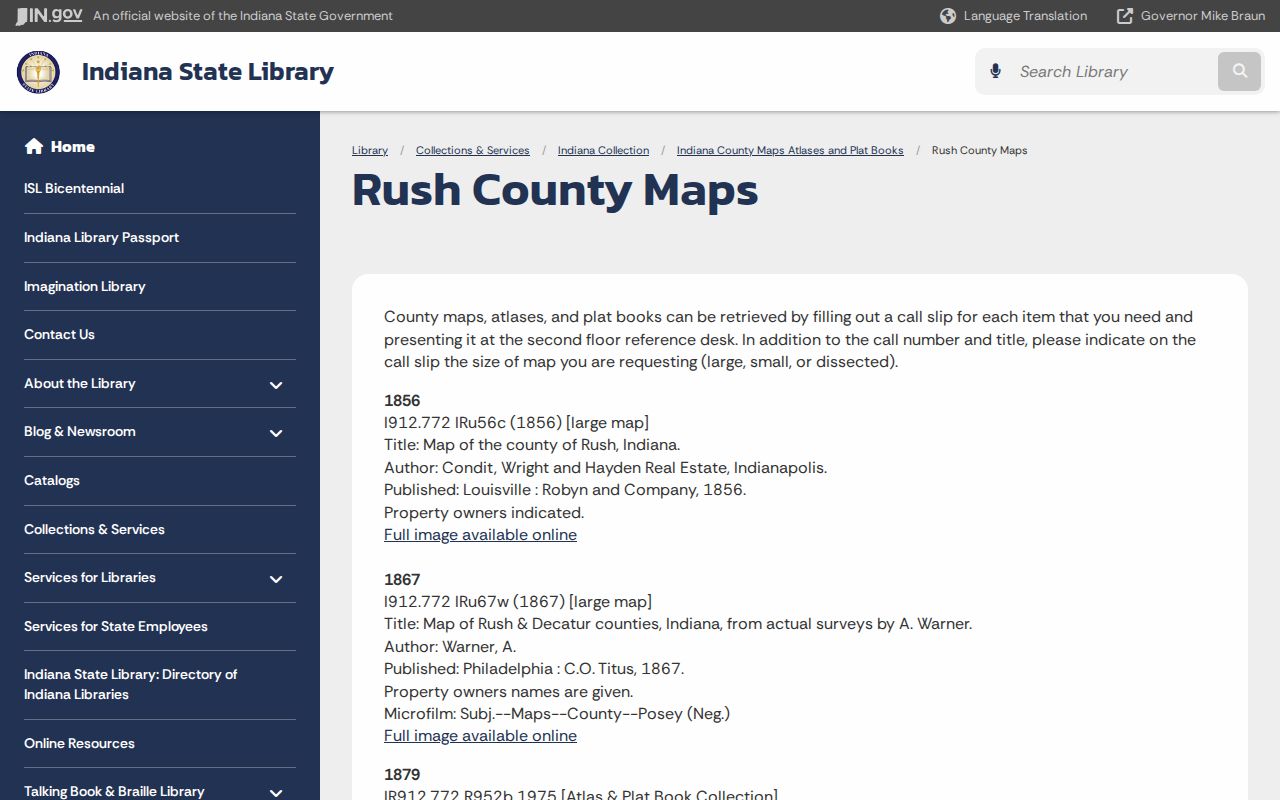
Treat a map label as a lead, never as proof of who held title. For real confirmation, go back to the Rush County deed records and pull the book, page, date, and legal description tied to that parcel.
Follow Rush County Former Owner Descriptions
Parcel numbers do not survive every rearrangement. Splits and combinations erase them. Street and postal labels change as well. Rushville's original commercial grid held 151 lots. Carthage was first platted in 1834, so lot-and-block wording often outlives a modern address.
Copy the current deed description in full. Include the predecessor key, subdivision, section-township-range data, and plat citation. The county publishes no official street-renumbering table, so invent no conversion. Historic directories and newspapers can suggest an address, yet only the deed chain confirms the former owners of record.
State Library directories add dated leads. Holdings include Rushville directories from 1901 and 1911, Polk directories from 1964, 1971, and 1972, and a regional directory covering Arlington, Carthage, Manilla, and Milroy for parts of 1988 through 2013. An entry ties a name to an address at one moment, which is occupancy context rather than a conveyance.
Separate Rushville's 1875 Record Loss
One 1875 loss trips up local researchers. Rushville history reports that early corporation records, including ordinance books and board minutes, were stolen and burned that year. Replacement municipal books were ordered afterward. That theft can explain a gap in city proceedings for a downtown property. It does not mean Rush County deed books burned. Keep the municipal story separate from Recorder and State Library deed coverage: ask for the replacement city books when the question is an early ordinance, and use county deeds for the ownership chain.
How Deep Rush County Ownership Runs
Rush County was formed in 1822, and its record trail follows that line closely. Deed microfilm located for the county starts a bit earlier, in 1820. First-purchase federal land is a different matter. The Indiana State Archives land collections hold tract books, plats, and matching indexes for those earliest sales. Anything later usually stayed with the county. That is where most former-owner work in Rush County begins and ends.
The Rush County Recorder keeps the current and later instruments. The State Library can confirm which microfilm ranges exist. Clerk records cover probate and partition branches that shaped many parcels. A directory listing, a newspaper notice, or a name on a historical map can suggest a query. It cannot close a gap in the deed chain, though.
Offline sources add texture once the official chain is logged. The Rushville Public Library Indiana Room holds directories and newspaper microfilm. The Rush County Historical Society works by appointment. The Genealogical Society preserves publications and cemetery material. Every item should carry a full citation. It should list repository, collection, volume or reel, page or frame, date, indexed name, and address. That citation lets you test a clue against the deed record itself. Do not trust it on faith alone.
Former owners hide in the indexes. They appear under initials, a spouse's name, an estate style, or an entity suffix. Search both grantor and grantee sides. Keep the exact indexed spelling. When two people share a name, the legal description and the adjoining owners usually separate them. Never force a chain across an unmatched tract just because the dates line up.
Newspaper reels offer a narrow but useful bridge. The Indiana Historical Society catalog lists the Rushville Jacksonian from 1856 through 1896. It also lists selected Rushville Republican years, and Rushville Telegram reels for 1943 and 1945. Sale, estate, and subdivision notices can surface a name or date worth testing. Coverage is spotty. A notice never proves a planned sale actually closed.
The State Archives split matters cleanly. Federal first-purchase records, plats, tract books, and WPA name indexes serve the start of the land trail. Later private transfers belong to the Recorder. A catalog number beginning with MF marks use-copy microfilm. Vault material may need a duplication or scan request. Keeping these layers straight prevents an early patent from being mistaken for a later owner of record. For each offline find, log the repository, collection, reel or volume, page or frame, date, and exact land clue. A clear citation lets another researcher retest the same lead. It also stops a map label or obituary from quietly becoming an ownership claim.
One caution on the early index ranges. Grantee reels begin in 1822, the located grantor range begins in 1827, and deed books begin in 1820. Treat those endpoints exactly. A missing name near an edge may call for browsing a deed book. It may also call for testing the other index side, or checking a tract or patent source. An absent entry does not prove no transfer occurred.
Lawful history research. Use prior-owner records for title, estate, or property history, never to track, expose, or harass a living person.